Dispatch
What is a fu? The Chinese talisman on the tape, explained
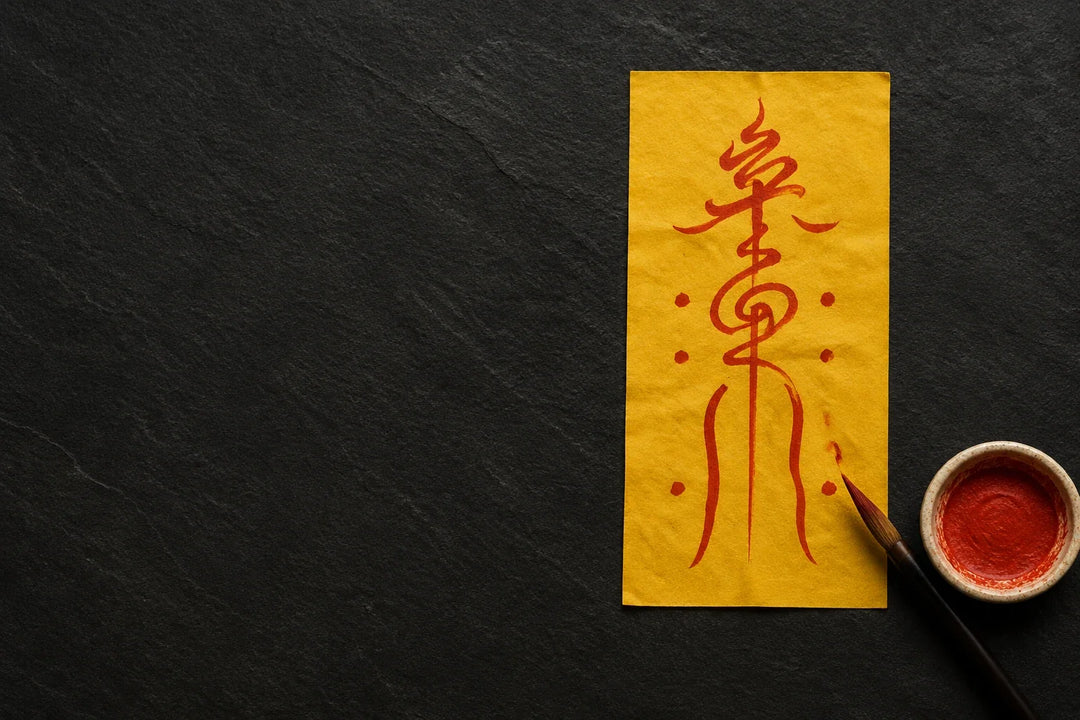
A fu (符) is a brush-written Daoist talisman on yellow paper, structured like a document: head, body, seal. Here is how it is built, why it is yellow and red, and what jiama charms bound to the legs are.
If you have arrived here because you saw yellow tape with red writing on a runner's legs, this is the short, honest explanation of what that writing is.
A fu is a written object, not a symbol
A fu (符) is a Chinese talisman: a charm written in brush and cinnabar-red ink, usually on yellow paper. The word originally meant a tally — a token split in two so that the halves could be matched to prove authority. That is the whole idea. A fu is one half of a matched pair. The other half is held elsewhere.
This is why a fu is written rather than drawn. It is treated as a document, and it is structured like one.
How a fu is put together
- The head. The opening marks at the top, which address the charm — the equivalent of a letterhead.
- The body. The dense middle section, where the charm's actual content sits. Characters here are often compressed, stacked or written in forms that do not appear in ordinary writing.
- The seal. The closing mark at the foot, which finishes the document. Without it the charm is considered unsent.
It reads top to bottom, right to left, and it is written in one pass. A fu that has been touched up afterwards is, by convention, not a fu.
Why yellow, why red
Yellow is the colour of earth and of the centre in the five-phase scheme — the neutral ground a document is written on. Red is cinnabar, the pigment used for seals and for anything that is meant to carry authority. A yellow field with red writing is, visually, the oldest official-document format in Chinese culture. Every Chinese person recognises it instantly, which is exactly why the tape reads as it does from across a finish area.
What a fu is used for
Historically: protection on a journey, safety in a house, marking a threshold, accompanying an intention. Some are pasted. Some are carried folded. Some are burned, with the ash taken in water. Some are bound to the body — and that last category is where the running talisman comes from.
The ones bound to the legs
Charms tied to the calves are called jiama (甲馬). They appear in Water Margin, bound to the legs of Dai Zong, the Divine Traveller, who covers five hundred li in a day and unties them when he stops. They are for one journey. They are not kept on afterwards.
Is this a religious object?
Honestly: it comes from a religious tradition. Daoist talismanic writing is a real practice with real lineages, and the charm reproduced on our tape was written by a priest working in that tradition, not designed by a studio. We reproduce it as written.
Whether you treat it as devotion, as heritage, or as a very good-looking piece of tape with a fifteen-hundred-year-old graphic on it is up to you. We make no claim about what it does to a body. What we can say is what it is, and what it is is written above.
What it is not
- Not a medical device, and not sold as one.
- Not a stock clip-art "Chinese symbol" — those are usually invented.
- Not a supplement, and not a substitute for training, food or sleep.